The Great Wall

In Beijing 

At the Forbidden City

At the Forbidden City


I have wanted to write for awhile now about the Olympic mascots for the upcoming games in China. I have included here a picture of Albert with some representations of these mascots that greeted us on the way into a Beijing mall. I noticed them because they are (1) everywhere and (2) interesting in light of my ongoing observations about the un-cuteness of India. By the way, Albert was not discriminated against at any Chinese venue and received many compliments during his stay there. In fact, my hostess learned the word for penguin in Chinese as a result of the comments he was drawing. I, naturally, forgot the word immediately.
Anyhow, the spirit of the 2008 games is represented by 5 "Fuwa" or "Friendlies," each of whom corresponds to one of the Olympic rings, a particular set of Olympic events, and to a Chinese mythological creature. All of the Fuwa are children and have very diminutive names - Beibei, Jingjing, Huanhuan, Yingying, Nini. If you eliminate the repetition of the syllables in their names, they spell out "Bei Jing huan ying ni" or "Beijing Welcomes You." Pretty cute, huh?
Their official website not only explains what athletic events each Friendly represents, it also explains the particular virtues embodied by each Fuwa, each of which is also one of the five elements of nature (sea, forest, fire, earth, and sky). It is reminescent of reading the placemat at a Chinese restaurant to learn about the animal sign for your year of birth. Jingjing brings joy to children everywhere. Huanhuan is enthusiastic and inviting. (Have you ever noticed how certain words, like "harmonious," immediately make one think of text on Chinese culture?)
Consider the following evidence:
Mali has the world's highest fertility rate (7.38 children per woman). And levels of ambient cuteness are shockingly low. Granted, Bedouin chic has a certain romance. But it is emphatically not adorable. Also on the high end of the fertility range and the low end of the warm-fuzzy meter are Yemen (6.49) and the Democratic Republic of Congo (5.99). Paraguay has a medium high fertility rate (3.84) and the main cultural currents there are militarism and a German flavor brought by Nazis fleeing prosecution for war crimes.
Then we get to India, with 2.81 children per woman. And India, as I have pointed out, trails the rest of Asia in the cute column.
The USA comes in at a middlingly level of fertility (2.09). (The world median, by the way, is Israel with 2.38 children per woman.) In the USA, while cute things are generally available, we are by no means a world leader in this field. (Sesame Street not withstanding). Much of our supply of animated creatures is imported from Britain or Asia. And companies that should be putting R&D into cuteness, such as Disney and Mattel, are instead pumping out work that emphasizes glamour, wealth, and a certain precocious (and creepy) sexuality. (See: Bratz, Disney Princesses).
China (1.75) is about on par with Finland (1.73). And Finland is a leader in grotesque-cute, trolls in particular. And, finally, we get to East Asia, the world epicenter of cuteness technology: South Korea (1.28), Japan (1.23), and, with the lowest fertility rates in the world, Hong Kong (0.98).
Anyone who writes to tell me that development is an omitted variable in my theory is totally uncute.
There is construction going on around my apartment and so I’ve been going to coffee shops to write quite a bit. Over the weekend, I wanted to break out of my Barista rut and chose to go to Brown Sugar, the other coffee shop that is less than ten minutes walk away. I really dislike Brown Sugar and wouldn’t have gone at all if it weren’t for the fact that they have milkshakes. My problem with the place is with the décor and becoming totally fascinated with what this décor looks like from the point of view of
My immediate cultural reference point for “Brown Sugar” is the song by the Rolling Stones, which I always thought was supposed to be a (shocking in its day) ode to the joys of sex with black women. But my friend Ed tells me brown sugar is also heroin. Anyhow, parts of the Brown Sugar coffee shop make me think that the owners, too, associate the phrase with drugs. The sign outside actually says “Brown Sugar: Get Yourself Addicted.” And then, inside, there is a bead curtain as you walk in and the windows are flanked with about two dozen large, colored glass bongs. (I wonder if kids still call them that.) The coffee shop does offer hookas, so smoking is sort of an appropriate note to strike. But I don’t see why they just don’t display hookas. The marijuana theme continues, see below, but there is definitely no heroin chic going on anywhere.
But on the wall to the right is an indication that the owners might have the African-American and Brown Sugar connection in mind after all. There are framed covers of American LPs and these are a celebration of 70s disco and promiscuous black people. There are two albums by Boney M. (“Night Flight to Venus” and “Take the Heat off Me”) that are representative of the motif: check these out at http://en.wikipedia.org/wiki/Boney_M. (This article is interesting in its own right since this group seems to have been the German – West Indies musical ancestor of Milli Vanilli.)
Two points: first, this doesn’t work with the marijuana references. It’s a drugs-music mis-pairing here. They need some
The mismatched cultural references continue. The actual music on the stereo is
I feel a need to defend my country from this décor. True, each one of the horrendous errors in taste that makes-up Brown Sugar has been committed by an American. But no one American could commit all these errors in taste!
Every time I’m in there I get to wondering what this looks like if you are Indian
I am sorry I have not up-dated my blog in a bit. My steady sweetie was in town during Thanksgiving week and after he left there was an extensive agenda of pining and self-pity that needed my urgent attention.
I am afraid I have more bad news about
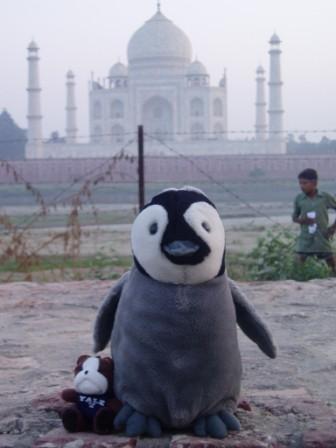
So here Albert and Norman are. Looking at the Taj from across the river, barbed wire cruelly obscuring their view and symbolizing their ghetto-ization in Indian society.
As was noted by Nora earlier this fall, the cutest people in the world are the Japanese. And, so, in honor of a society that understands the importance of plush animals, the rest of this post will be in haiku.
OhOkay, I admit my invention for saving the roads of the third world was half-baked, but this time I am really on to something.
One of the questions I ask myself from time to time is whether
So I always wonder if
I think
But
The solution wouldn’t be so hard if politicians wanted to do something about it.
So, my idea is: Indian Law and Order!
No, I’m serious.
What
The show would begin with a parental yet passionate voice that would inform the viewers that in the criminal justice system they are represented by two separate, yet equally important, groups: the police who investigate crime and the courts who prosecute the offenders. Then the viewers would watch as the honorable, diligent, and muscular policeman used carefully collected physical evidence and legally obtained confessions to break the case. Then the incorruptible, clever, and shapely prosecutor would see that the dastardly criminal was locked away for ever. This would all take about 60 minutes (minus time for commercials) and the victim’s family would be crying gratefully as the judge announced the verdict. (No jury trials in India). The victim’s family would be mostly cameos by beautiful film stars and cricket players.
I know this idea might sound trivial, but the idea comes from a study that shows that both male and female respondents' expressed belief in the acceptability of domestic violence went down in rural India as TV came into the area. The investigators believe that is because Indian soap operas show less patriarchal families. Maybe the respondents just learned from the TV that they should self-censor. But, still, changing people's minds about what's normal/cool/tasteful/upper-class is a real change.

