I've been hitting the road in the spirit of truly comparative political science, going to last week to see my good friend and fellow field worker, Charlotte. I spent 8 days in Beijing. And now I can report back on all those "India versus China" comparisons one sees in The Economist, FT, and other papers. The outlines of the comparison that I had in mind going in: China is richer, but it's got an autocratic and corrupt system of government. India is poorer, but it's corrupt system of government is a democracy, so it might pull through in the end. (e.g. Thomas Friedman aka "that hack who has his own NYT colum despite the fact that he somehow thinks it is legitimate research to extract a whole theory of the Arab world out of happening to notice Chinese phone card salespeople" wrote on this point in 2005).
Still, even though I knew that these many journalistic comparisons all point out that China is the richer place (GDP/capita of about $7800 versus $3800 in India), I guess I still kind of thought that the presence of all these comparative pieces meant that the two countries were be more, well, comparable.
Now that I've been there, I'm amazed. Beijing is so fancy!!! There are so many skyscrapers and fancy malls. But it wasn't the private opulence that really struck me, but the lack of dump-like-ness that was so very un-Indian. We drove and walked over at least a fair portion of the city and I didn't see any shanty towns and only one beggar. The buildings are toasty warm , despite the snow outside, because of decent utilities. The roads have no potholes but do have sidewalks. And not just sidewalks but sidewalks with markings to aid blind people is recognizing they are coming to a curb. There isn't trash in huge piles anywhere. The buses are really clean and shiny. The cabs are all reasonably new cars and ALL of them use the meter instead of haggling for the price.
Of course, Beijing is also a showpiece city, especially with the Olympics coming up. The government no doubt threw a lot of homeless people out and maybe even razed housing to put up skyscrapers. And there are huge disparities between the city and the countryside. But even comparing oranges and oranges, India looks pretty bad. I live in India's capital and I've been to Mumbai, Kolkata, and Bangalore -- these are the cities that are getting India's new Chanel outlets, but they don't look like Beijing. And, frankly, India's government couldn't decide to raze the shanty towns of Delhi because of an up-coming international sporting event: doing so would create too much open space.
This is part of what makes political science so tricky. China scholars say their country is really corrupt. India scholars say their country is really corrupt. Scholars of both countries lament that the government is dependent on this corruption for stability so that even when the state wants to do something well, it often fails. But China's roads are SO much better. So, are China scholars just deluded about what actually constitutes "a lot" of corruption, sort of like when people in Florida wear sweaters because it is sixty degrees and, therefore, "cold"? Or is China somehow differently corrupt, in a way that makes its roads come out better?
Also, how do we figure out how important this "India is a democracy and China isn't" part of the comparison actually is? Particularly because both countries have a big gap between the laws on the books and what the judiciary actually does: so how much do the laws matter for the comparison? India is a lot more internally violent, though one can probably argue that China is more repressive. But both India and China get very, very bad marks from Amnesty International and keep parts of their country off-limits to foreigners, so how to know which country is likely to have more problems in future with internal stability?
I really want some of my China scholar friends to come here and tell me whether India looks like it is on track to be like China. China's GDP/capita is higher than India's. So maybe India is like China ten or fifteen years ago? Or maybe India is, as my boyfriend suggested, like "Bolivia if no one took care of it"? These options imply very different futures for my Indian friends.
------
Stay tuned for more on "India versus China: Is this Comparison Really Worth Making?" series. Because I'm out of time now but I still have to explain my whole theory of how China's Olympic mascots reveal the reasons for differential success in population control between the two countries.
Tuesday, December 18, 2007


Thursday, December 6, 2007
The tragic decorating consequences of the fad for English language signage
There is construction going on around my apartment and so I’ve been going to coffee shops to write quite a bit. Over the weekend, I wanted to break out of my Barista rut and chose to go to Brown Sugar, the other coffee shop that is less than ten minutes walk away. I really dislike Brown Sugar and wouldn’t have gone at all if it weren’t for the fact that they have milkshakes. My problem with the place is with the décor and becoming totally fascinated with what this décor looks like from the point of view of
My immediate cultural reference point for “Brown Sugar” is the song by the Rolling Stones, which I always thought was supposed to be a (shocking in its day) ode to the joys of sex with black women. But my friend Ed tells me brown sugar is also heroin. Anyhow, parts of the Brown Sugar coffee shop make me think that the owners, too, associate the phrase with drugs. The sign outside actually says “Brown Sugar: Get Yourself Addicted.” And then, inside, there is a bead curtain as you walk in and the windows are flanked with about two dozen large, colored glass bongs. (I wonder if kids still call them that.) The coffee shop does offer hookas, so smoking is sort of an appropriate note to strike. But I don’t see why they just don’t display hookas. The marijuana theme continues, see below, but there is definitely no heroin chic going on anywhere.
But on the wall to the right is an indication that the owners might have the African-American and Brown Sugar connection in mind after all. There are framed covers of American LPs and these are a celebration of 70s disco and promiscuous black people. There are two albums by Boney M. (“Night Flight to Venus” and “Take the Heat off Me”) that are representative of the motif: check these out at http://en.wikipedia.org/wiki/Boney_M. (This article is interesting in its own right since this group seems to have been the German – West Indies musical ancestor of Milli Vanilli.)
Two points: first, this doesn’t work with the marijuana references. It’s a drugs-music mis-pairing here. They need some
The mismatched cultural references continue. The actual music on the stereo is
I feel a need to defend my country from this décor. True, each one of the horrendous errors in taste that makes-up Brown Sugar has been committed by an American. But no one American could commit all these errors in taste!
Every time I’m in there I get to wondering what this looks like if you are Indian
Friday, November 30, 2007
The ugliness continues
I am sorry I have not up-dated my blog in a bit. My steady sweetie was in town during Thanksgiving week and after he left there was an extensive agenda of pining and self-pity that needed my urgent attention.
I am afraid I have more bad news about
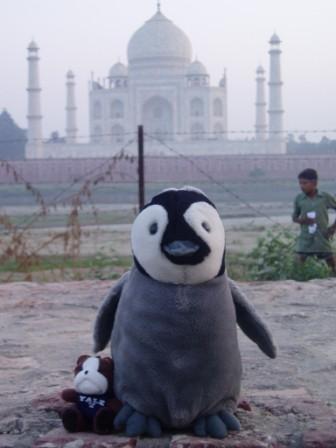
So here Albert and Norman are. Looking at the Taj from across the river, barbed wire cruelly obscuring their view and symbolizing their ghetto-ization in Indian society.
As was noted by Nora earlier this fall, the cutest people in the world are the Japanese. And, so, in honor of a society that understands the importance of plush animals, the rest of this post will be in haiku.
Ohare you so very uncute?
Penguin haters all.
Maybe all the air
pollution drags cute moods down.
The sky IS yellow.
need to do something pronto.
The air is all smoke.
An
asked “which country” [are you from]?
I said the
And he replied with
“Me:
was there any doubt?
When I ask “where from?”
most answer like I am nuts.
“What does it look like?”
No one says that. But
they do seem to imply it.
What is the reason?
Whites ask no questions?
That I wouldn’t know their town?
Or, why would I care?
It is a very
asymmetric way to chat.
Not this little kid.
Of course I would care!
He’s from
definitely know.
Haiku is the best
type of poetry of all.
Rhyming is too hard.
Do not write to tell
me I counted the lines wrong.
Syllables are tricky.
Saturday, November 17, 2007
The Solution to all India's Problems
Okay, I admit my invention for saving the roads of the third world was half-baked, but this time I am really on to something.
One of the questions I ask myself from time to time is whether
So I always wonder if
I think
But
The solution wouldn’t be so hard if politicians wanted to do something about it.
So, my idea is: Indian Law and Order!
No, I’m serious.
What
The show would begin with a parental yet passionate voice that would inform the viewers that in the criminal justice system they are represented by two separate, yet equally important, groups: the police who investigate crime and the courts who prosecute the offenders. Then the viewers would watch as the honorable, diligent, and muscular policeman used carefully collected physical evidence and legally obtained confessions to break the case. Then the incorruptible, clever, and shapely prosecutor would see that the dastardly criminal was locked away for ever. This would all take about 60 minutes (minus time for commercials) and the victim’s family would be crying gratefully as the judge announced the verdict. (No jury trials in India). The victim’s family would be mostly cameos by beautiful film stars and cricket players.
I know this idea might sound trivial, but the idea comes from a study that shows that both male and female respondents' expressed belief in the acceptability of domestic violence went down in rural India as TV came into the area. The investigators believe that is because Indian soap operas show less patriarchal families. Maybe the respondents just learned from the TV that they should self-censor. But, still, changing people's minds about what's normal/cool/tasteful/upper-class is a real change.
Monday, November 12, 2007
Be Careful What You Wish For
Wouldn’t you know it? I go to the protest safely, get back to Darjeeling City, have lunch, and get food poisoning. Just like Ghising, blind to where the true danger lies…
Also, I should never have made fun of India’s effete strike culture. Now Kolkata is on strike in earnest, and I’m stuck here for the next forty-eight hours. And I mean stuck here. At my hotel and its immediate environs. No vehicles today.
By the way, I have figured out why the change from Calcutta to Kolkata bothers me so much more than Benares nee Varanasi or Mumbai nee Bombay. It’s because English words just don’t begin with “ko.” I think koala and kohlrabi are the only two words in common circulation that start with “ko.” And those are hardly your good ol’ Aryan or Romance language nouns.
And no common English word begins with “kol.” I don’t have any idea how to tackle pronouncing that. I realize the intent is to revive indigenous traditions, but the whole point of a transliteration is to communicate how to say a word to people who don’t read your alphabet. And those people, even the kohlrabi and koala lovers among them, don’t know how to pronounce “kol.”
It doesn’t help that everyone says “Cal-cut-ahh.” I don’t know if that is because “Kolkata” is pronounced “Cal-cut-ahh” or because the name change hasn’t really caught on. I need some of those little cartoon speech bubbles.
Also, I should never have made fun of India’s effete strike culture. Now Kolkata is on strike in earnest, and I’m stuck here for the next forty-eight hours. And I mean stuck here. At my hotel and its immediate environs. No vehicles today.
By the way, I have figured out why the change from Calcutta to Kolkata bothers me so much more than Benares nee Varanasi or Mumbai nee Bombay. It’s because English words just don’t begin with “ko.” I think koala and kohlrabi are the only two words in common circulation that start with “ko.” And those are hardly your good ol’ Aryan or Romance language nouns.
And no common English word begins with “kol.” I don’t have any idea how to tackle pronouncing that. I realize the intent is to revive indigenous traditions, but the whole point of a transliteration is to communicate how to say a word to people who don’t read your alphabet. And those people, even the kohlrabi and koala lovers among them, don’t know how to pronounce “kol.”
It doesn’t help that everyone says “Cal-cut-ahh.” I don’t know if that is because “Kolkata” is pronounced “Cal-cut-ahh” or because the name change hasn’t really caught on. I need some of those little cartoon speech bubbles.
Wednesday, November 7, 2007
Indian Idol Really Does Explain Everything!
So, I went to the gherao and all was fine. PowerPoint-friendly pictures obtained.
There was a little change in plans overnight, actually. The GLF decided that they would do two days of gherao now, then take a break for Diwali, then finish up after that. The break for Diwali is, so say the leaders, in deference to the tourist industry. (Lousy backpacking foreigners. Messing with my field work.) This further illustrates my point about Indian civil disobedience lacking a sense of urgency. By the way, if you do not know what Diwali is you may want to refer to the episode of The Office that explicates the holiday in full.
The sit-in part of the gherao never really happened. The plan was to march from the city center to the headquarters of the district and blockade that. But the police had three successive roadblocks (complete with batons, riot shields, tear gas, and assault rifles. Singing: “one of these things is not like the others...”) several hundred meters away from the marchers’ target. I arrived at the roadblocks about 30 minutes before the procession did and was waved through, and was able to watch what happened from further up the road. For awhile the police were chatting with me and asking how their guns compared to those of US cops (I made something up) but then a supervisor shooed me pretty far away. But I still had an okay view.
As it turned out, there was nothing for the police to worry about this time. The protest got to the blockade, the leaders made some speeches, and then the group turned around and went to a different meeting point where more speeches were made. Then they dispersed, although the whole thing is supposed to repeat tomorrow.
This gherao, by the way, was even less like a proper sit-in than the semester during my college years when a bunch of students camped in front of the president’s office demanding that no sweatshops be involved in the manufacture of the school’s paraphernalia. Similar to recent events in Myanmar, after a few weeks the Yale junta rolled out its ruthless strategy for breaking the resolve of the valiant protesters: mid-term exams. And that was that.
On the other hand, judged by the standards of a political rally rather than as a gherao, the GLF effort was thoroughly respectable. Lots of call-and-answer chanting, sign boards, flags, the whole works.
My sister asked why they are protesting if they want the same thing their current leader does. (For those of you waiting with bated breathe for my dissertation, be warned that there are several spoilers below). The deal is that Subash Ghising, the man who led the GNLF’s drive for a state in the 1980s, has dominated politics for twenty years now, has been putting off elections for the post he controls for about seven years, and was for a long time beyond criticism because of his role as head of the Darjeeling movement. Sort of the Yasser Arafat of Darjeeling. Sans head scarf.
These new protests are basically being organized by politicians who want to oust Ghising. It is interesting that they cannot just protest against him on the grounds that he is not particularly skilled as an administrator, a crook, and a murderer, and instead they protest for statehood. I think one part of it is that a separate state is genuinely popular and by taking a more extreme position than Ghising (statehood now versus eventually) they are hoping to win away part of his luster as father of the movement. And then there is the fact that most of these politicians were in Ghising’s party up until a few weeks ago. And are mostly incompetents, crooks, and murderers themselves.
These politicians didn’t suddenly see the error of their ways – they saw an opportunity to capitalize on Ghising’s all-time low in popularity. And, here’s the amazing part: this actually IS because of Indian Idol!!!! Simon Cowell should be so depressed at the irrelevance of his show by comparison with the Indian version!! Kelly Clarkson notwithstanding, I don’t think American Idol has a single social movement to its credit.
To be more specific, Ghising has lost the hearts of the Darjeeling folk for his failure to support Darjeeling’s recent Indian Idol champion, Prashant Tamang.
You see, Ghising was out of the country during most of the competition. By contrast: You remember runner-up Amit Paul of Shillong? The Chief Minister THERE donated a bunch of money to the phone companies so that his constituents could text in their votes for Amit for free. Politicians elsewhere made a big show of selling their assets to sponsor free SMS-ing or gave cars, land, houses and so forth to the local contender. Indian Idol is serious business: 370 million votes were cast this time around. And Ghising just totally dropped the ball.
The irony of someone surviving seven years of postponing elections and then falling on the sword of a musical talent search is amazing, don’t you think? I guess we know what would revive public interest in Indian politics, though: more ensemble dance numbers.
There was a little change in plans overnight, actually. The GLF decided that they would do two days of gherao now, then take a break for Diwali, then finish up after that. The break for Diwali is, so say the leaders, in deference to the tourist industry. (Lousy backpacking foreigners. Messing with my field work.) This further illustrates my point about Indian civil disobedience lacking a sense of urgency. By the way, if you do not know what Diwali is you may want to refer to the episode of The Office that explicates the holiday in full.
The sit-in part of the gherao never really happened. The plan was to march from the city center to the headquarters of the district and blockade that. But the police had three successive roadblocks (complete with batons, riot shields, tear gas, and assault rifles. Singing: “one of these things is not like the others...”) several hundred meters away from the marchers’ target. I arrived at the roadblocks about 30 minutes before the procession did and was waved through, and was able to watch what happened from further up the road. For awhile the police were chatting with me and asking how their guns compared to those of US cops (I made something up) but then a supervisor shooed me pretty far away. But I still had an okay view.
As it turned out, there was nothing for the police to worry about this time. The protest got to the blockade, the leaders made some speeches, and then the group turned around and went to a different meeting point where more speeches were made. Then they dispersed, although the whole thing is supposed to repeat tomorrow.
This gherao, by the way, was even less like a proper sit-in than the semester during my college years when a bunch of students camped in front of the president’s office demanding that no sweatshops be involved in the manufacture of the school’s paraphernalia. Similar to recent events in Myanmar, after a few weeks the Yale junta rolled out its ruthless strategy for breaking the resolve of the valiant protesters: mid-term exams. And that was that.
On the other hand, judged by the standards of a political rally rather than as a gherao, the GLF effort was thoroughly respectable. Lots of call-and-answer chanting, sign boards, flags, the whole works.
My sister asked why they are protesting if they want the same thing their current leader does. (For those of you waiting with bated breathe for my dissertation, be warned that there are several spoilers below). The deal is that Subash Ghising, the man who led the GNLF’s drive for a state in the 1980s, has dominated politics for twenty years now, has been putting off elections for the post he controls for about seven years, and was for a long time beyond criticism because of his role as head of the Darjeeling movement. Sort of the Yasser Arafat of Darjeeling. Sans head scarf.
These new protests are basically being organized by politicians who want to oust Ghising. It is interesting that they cannot just protest against him on the grounds that he is not particularly skilled as an administrator, a crook, and a murderer, and instead they protest for statehood. I think one part of it is that a separate state is genuinely popular and by taking a more extreme position than Ghising (statehood now versus eventually) they are hoping to win away part of his luster as father of the movement. And then there is the fact that most of these politicians were in Ghising’s party up until a few weeks ago. And are mostly incompetents, crooks, and murderers themselves.
These politicians didn’t suddenly see the error of their ways – they saw an opportunity to capitalize on Ghising’s all-time low in popularity. And, here’s the amazing part: this actually IS because of Indian Idol!!!! Simon Cowell should be so depressed at the irrelevance of his show by comparison with the Indian version!! Kelly Clarkson notwithstanding, I don’t think American Idol has a single social movement to its credit.
To be more specific, Ghising has lost the hearts of the Darjeeling folk for his failure to support Darjeeling’s recent Indian Idol champion, Prashant Tamang.
You see, Ghising was out of the country during most of the competition. By contrast: You remember runner-up Amit Paul of Shillong? The Chief Minister THERE donated a bunch of money to the phone companies so that his constituents could text in their votes for Amit for free. Politicians elsewhere made a big show of selling their assets to sponsor free SMS-ing or gave cars, land, houses and so forth to the local contender. Indian Idol is serious business: 370 million votes were cast this time around. And Ghising just totally dropped the ball.
The irony of someone surviving seven years of postponing elections and then falling on the sword of a musical talent search is amazing, don’t you think? I guess we know what would revive public interest in Indian politics, though: more ensemble dance numbers.
Tuesday, November 6, 2007
POLL! Important Fieldwork Dilemma!
Okay, quick, I need advice. A moment of fieldwork glory (or at least good pictures for PowerPoint presentations) is within reach. But I'm a wee bit uncertain as to whether it is a good idea to pursue it.
(Mom: don't read any more of this post. It will only make you worried.)
Tomorrow there is a gherao here in Darjeeling by the Gorkha League. Now, who, you ask, are they? To answer that question requires a journey back to 1985. (Which you may recognize as the year "We are the World" spent four weeks at number one on the Hot 100 Billboard.) That year a group called the Gorkha National Liberation Front (GNLF) started getting all feisty about wanting their own state, Darjeeling, rather than being a part of West Bengal. Actually, in a country less insanely violent than India, it probably would have been pretty alarming. Because the GNLF had little gangs of young men who would go around and collect "donations" and would get into fights with representatives of the ruling political party.
This being India, it was only a little alarming. There are plenty more unemployed young men where those came from, but these sorts of things can be bad for the tea barons. So the GNLF didn't win a new state with their agitation, but they got an autonomous district.
Fastforward, and now there is this new political party, the Gorkha League, that is taking back up the cause of having a Darjeeling state. Tomorrow, they are going to begin a 15-day gherao at the headquarters of the Darjeeling autonomous district. A gherao is like a sit-in, except that it is announced in advance. And you announce your quit date in advance. That way, there is no danger that your resolve will been seen to crack, as it might in an indefinite sit-in.
By the way, Indians have a way with this kind of face-saving civil disobedience. When I was in Kolkatta last week, for instance, the Communist Party called a one-day general strike but announced an exemption for the IT sector. The disappointment of the IT comrades at being excluded from the day of solidarity was probably not too severe, however. Because, you see, computer companies tend not to be hot-beds of anti-capitalist activism. So it was kind of the equivalent of not inviting the Prom Queen out -- you aren't fooling anybody into thinking you wouldn't be rejected if you tried.
To get back to the point: it is kind of possible that these Gorkha League sit-inners will get into a scuffle with the GNLF folks at some point. And one of my goals for this dissertation about violence is that I will never actually have to observe any of it.
I think I will go and have a look, see how freely alcohol is flowing and whether there are any women at all there (a good barometer of what the intention of the gathering is), and then go away with a few PowerPoint-friendly pictures if things look ominous. But, what is your advice: take the poll below, please!!! And feel free to add comments. I value your collective wisdom on this point.
(Mom: don't read any more of this post. It will only make you worried.)
Tomorrow there is a gherao here in Darjeeling by the Gorkha League. Now, who, you ask, are they? To answer that question requires a journey back to 1985. (Which you may recognize as the year "We are the World" spent four weeks at number one on the Hot 100 Billboard.) That year a group called the Gorkha National Liberation Front (GNLF) started getting all feisty about wanting their own state, Darjeeling, rather than being a part of West Bengal. Actually, in a country less insanely violent than India, it probably would have been pretty alarming. Because the GNLF had little gangs of young men who would go around and collect "donations" and would get into fights with representatives of the ruling political party.
This being India, it was only a little alarming. There are plenty more unemployed young men where those came from, but these sorts of things can be bad for the tea barons. So the GNLF didn't win a new state with their agitation, but they got an autonomous district.
Fastforward, and now there is this new political party, the Gorkha League, that is taking back up the cause of having a Darjeeling state. Tomorrow, they are going to begin a 15-day gherao at the headquarters of the Darjeeling autonomous district. A gherao is like a sit-in, except that it is announced in advance. And you announce your quit date in advance. That way, there is no danger that your resolve will been seen to crack, as it might in an indefinite sit-in.
By the way, Indians have a way with this kind of face-saving civil disobedience. When I was in Kolkatta last week, for instance, the Communist Party called a one-day general strike but announced an exemption for the IT sector. The disappointment of the IT comrades at being excluded from the day of solidarity was probably not too severe, however. Because, you see, computer companies tend not to be hot-beds of anti-capitalist activism. So it was kind of the equivalent of not inviting the Prom Queen out -- you aren't fooling anybody into thinking you wouldn't be rejected if you tried.
To get back to the point: it is kind of possible that these Gorkha League sit-inners will get into a scuffle with the GNLF folks at some point. And one of my goals for this dissertation about violence is that I will never actually have to observe any of it.
I think I will go and have a look, see how freely alcohol is flowing and whether there are any women at all there (a good barometer of what the intention of the gathering is), and then go away with a few PowerPoint-friendly pictures if things look ominous. But, what is your advice: take the poll below, please!!! And feel free to add comments. I value your collective wisdom on this point.
Subscribe to:
Posts (Atom)